If you’ve opened your laptop lately, looked at a to-do list with fourteen different marketing tasks on it, and felt a slight wave of exhaustion—you aren’t alone.
Marketing in 2026 looks entirely different than it did just a couple of years ago. Tasks that used to eat up an entire afternoon—drafting five versions of ad copy, pulling keyword clusters, building out social Marketing graphics, or setting up email sequences—can now get off the ground in a matter of minutes.
But here’s the unvarnished truth: most AI marketing tools are noise.
Some promise to run your entire business while you sleep, only to output generic garbage that sounds like an instruction manual written by a robot. Others are genuinely brilliant at one specific task, but end up adding more complexity to your day because they don’t integrate with anything else you use.
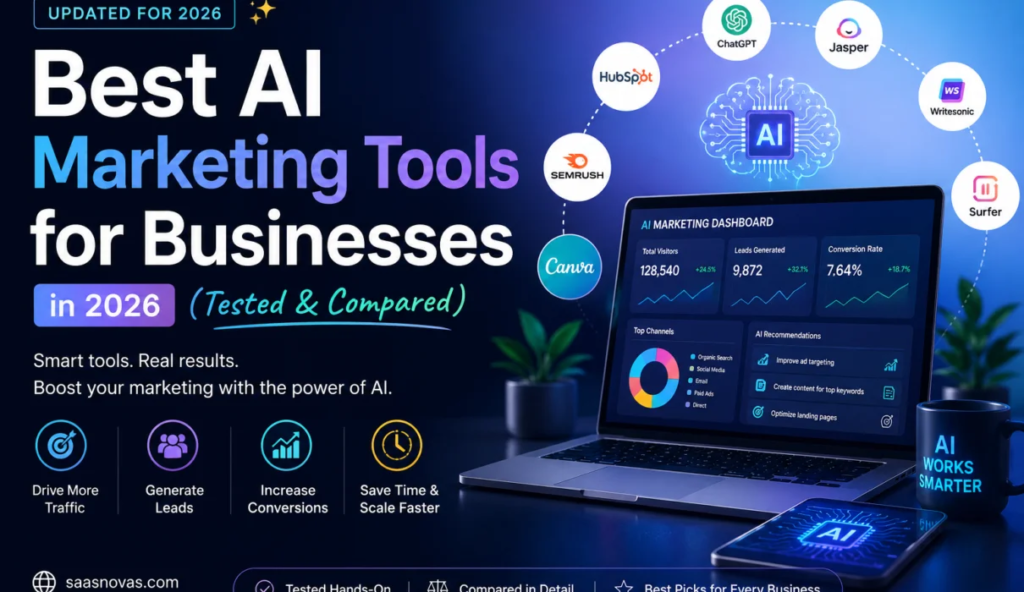
Instead of treating AI like a magic button or collecting shiny subscriptions you’ll forget to cancel, let’s cut through the hype. This guide breaks down what the top AI marketing tools actually do, who they are built for, how to avoid common traps, and how to keep your content feeling authentic and human.
The 2026 Landscape: What Changed?
A few years ago, using AI in marketing meant copy-pasting a prompt into a text box, getting a somewhat clumsy paragraph, and spending twenty minutes editing out weird adjectives.
Today, the shift isn’t just about generating text—it’s about workflow integration.
Modern marketing tools don’t just write sentences; they connect data, automate manual tasks, analyze competitor rank strategies, and help lean teams operate with the output of a full agency.
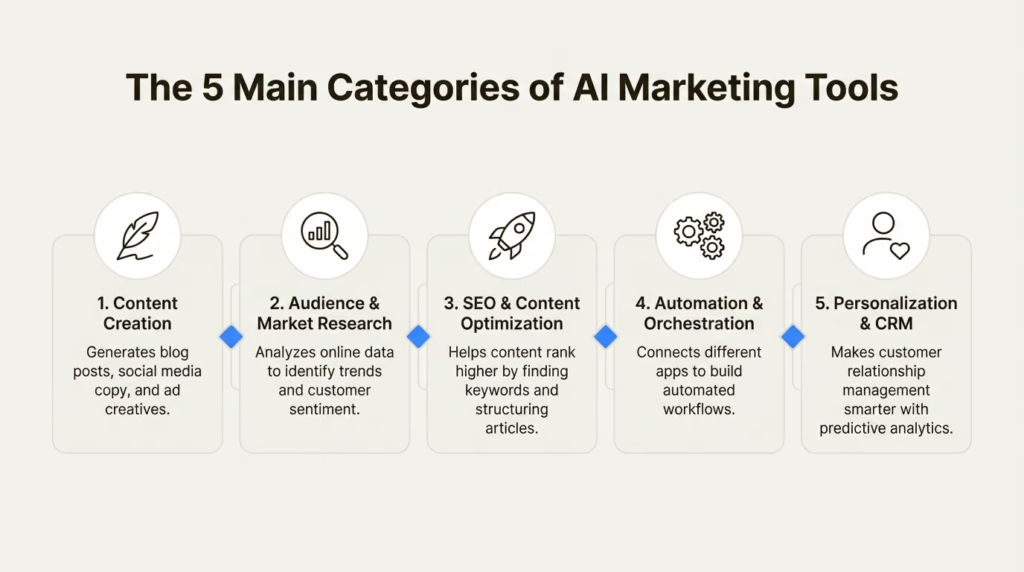
Here is what modern marketing AI is actually taking off your plate:
- Eliminating the “blank page syndrome” when starting new campaigns or articles.
- Pattern recognition in heavy data sets (like figuring out which ad headlines convert best).
- Repetitive format shifts (turning one long-form blog post into newsletter copy, LinkedIn posts, and short scripts).
- Automating digital admin (moving leads from forms into CRMs without manual data entry).
Best AI Marketing Tools at a Glance
Before we dive into detailed reviews of each platform, here is a quick real-world cheatsheet to help you match your daily headaches with the right solution.
| Your Primary Daily Headache | The Best Tool | What It Actually Does Well | The Honest Drawback |
| Drowning in tab switches between CRM, email, and analytics | HubSpot Marketing Hub | Connects lead tracking, emails, and content into one connected engine. | Gets expensive fast as your contact database grows. |
| Producing high-volume content that needs to match brand tone | Jasper | Learns your brand voice guidelines so team drafts sound unified. | Overkill if you only publish a few captions a week. |
| Trying to rank on Google without guessing keywords | Surfer SEO | Gives real-time structural and keyword targets based on top competitors. | Can trick you into writing for search bots instead of real people. |
| Designing social graphics without a full design team | Canva AI | Turns quick text prompts and rough ideas into branded visuals. | Lacks the deep control of professional suites like Photoshop. |
| Stuck in manual steps (Brief $\rightarrow$ Article $\rightarrow$ Email $\rightarrow$ Post) | Copy.ai | Maps and automates multi-step marketing workflows end-to-end. | Takes time and trial-and-error to set up custom workflows. |
| Staring at blank ad templates wondering what will convert | Anyword | Focuses on performance ad copy with predictive conversion scoring. | Very specialized—mostly useful if you run active paid ad budgets. |
| Manually copying lead data across different web apps | Zapier | Acts as background glue, transferring info automatically between apps. | Building and troubleshooting multi-step “Zaps” takes patience. |
| Brainstorming angles or outlining fresh strategies | ChatGPT | Flexible everyday partner for research, drafting, and problem-solving. | Needs clear context and guidance to avoid generic responses. |
Deep-Dive Reviews: The Tools Worth Your Time
1. HubSpot Marketing Hub – Best for All-in-One Operations
If your team spends half its morning switching between an email sender, an analytics dashboard, a social media scheduler, and a separate CRM, HubSpot remains the heavy hitter.
Rather than treating AI as an isolated plugin, HubSpot bakes machine learning right into its central ecosystem. Its internal AI tools (like Breeze AI) assist with everything from drafting email subject lines and summarizing lead behavior to predicting churn and generating landing page layouts.
- Who it’s for: Growing businesses, mid-market marketing teams, and companies already committed to a structured CRM pipeline.
- Why it works: Convenience. You don’t have to export CSV files or bridge multiple apps to see how an AI-drafted email campaign impacted revenue.
- The reality check: HubSpot is a long-term investment. If you’re a solo creator or a tiny startup on a tight budget, the entry costs can feel steep once you move past basic tiers.
2. Jasper – Best for Scaling Content Teams
Jasper was built specifically for marketing teams from day one, which sets it apart from general-purpose AI chat assistants.
Its strongest selling point is its Brand Voice engine. You can upload your style guide, company background, press releases, and tone examples. When your team members draft content, Jasper enforces those rules, ensuring your tone remains consistent whether a veteran strategist or a junior intern is writing.
- Who it’s for: Content teams, marketing agencies, and brands producing blog articles, emails, and campaign materials at scale.
- Why it works: It accelerates initial drafts dramatically while keeping language alignment across team members.
- The reality check: It isn’t a “set and forget” tool. Drafts still require human editing to add fresh takes, check facts, and remove repetitive phrases.
3. Surfer SEO – Best for Organic Search Growth
Writing great content is only half the battle; people actually need to find it. Surfer SEO removes the guesswork from search engine optimization by analyzing the pages currently ranking on page one of Google for your target keyword.
Instead of just telling you to “write good content,” it gives you an interactive score sheet. As you write, it gives feedback on structural metrics—word count ranges, heading counts, image counts, and semantic keywords you should include.
- Who it’s for: SEO strategists, niche bloggers, in-house content writers, and growth marketers focused on organic traffic.
- Why it works: It turns abstract search engine optimization into a clear, measurable checklist.
- The reality check: Don’t treat the score like a religion. If you stuff words into sentences just to make a meter turn green, real humans will bounce off your page—and Google will eventually penalize the awkward reading experience anyway.
4. Canva AI – Best for Visual & Social Content
Marketing isn’t just paragraphs; it’s visual storytelling. Social media graphics, ad banners, presentation decks, video thumbnails, and blog header images all demand constant design output.
Canva has integrated AI (Magic Studio) directly into its intuitive design workspace. You can generate image assets from text descriptions, instantly remove image backgrounds, extend photo framing, or automatically reformat a square Instagram graphic into a vertical Story layout with one click.
- Who it’s for: Social media managers, solo entrepreneurs, content creators, and marketing teams without dedicated visual designers.
- Why it works: It lets non-designers produce clean, high-quality visual content in minutes without dealing with steep design software learning curves.
- The reality check: It won’t replace custom brand photography or complex 3D graphic design, but for day-to-day social execution, it’s unmatched.
5. Copy.ai – Best for Marketing Workflows & Automation
Copy.ai started as a simple headline generator, but it has evolved into a powerful platform focused on go-to-market workflows.
Instead of writing one piece of copy at a time, Copy.ai allows you to map out multi-step processes. For instance, you can set up a rule where the system takes a new product release brief, generates a launch blog draft, extracts five bullet points for a newsletter, creates three unique ad variants, and formats a social announcement—all in a single sequence.
- Who it’s for: Lean marketing teams looking to eliminate repetitive copy-pasting and manual reformatting.
- Why it works: It shifts the focus from “writing a single post” to “automating an entire content supply chain.”
- The reality check: Custom workflows require careful testing. If your initial inputs or brief templates are vague, the automated output down the chain will be equally bland.
6. Anyword – Best for Performance & Ad Copy
If your job involves managing ad spend on Meta, Google, or LinkedIn, writing copy that “sounds nice” isn’t enough—it has to convert.
Anyword is built around data-driven performance copywriting. It evaluates copy variations against a database of historical marketing performance, giving your headlines, calls-to-action, and ad bodies a Predictive Performance Score. It also tailors language variants based on specific buyer personas.
- Who it’s for: Media buyers, performance marketers, ad agencies, and growth teams running paid traffic.
- Why it works: It takes the emotion and guesswork out of A/B testing by giving you data-backed direction before you spend ad budget.
- The reality check: If you are primarily focused on long-form brand storytelling or organic community building, Anyword’s hyper-focused ad formulas won’t give you much value.
7. Zapier – Best for Backend Marketing Automation
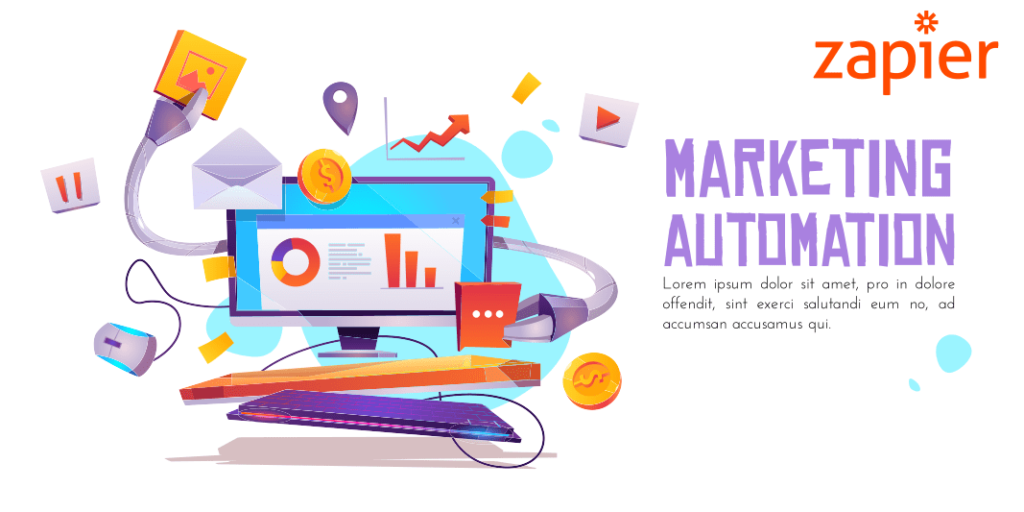
Sometimes your biggest time-drain isn’t creating content at all—it’s moving customer data, lead forms, and files between five different web applications.
Zapier acts as digital glue for your tech stack. With its built-in AI assistant, you can describe an automation in plain English (e.g., “When a new lead submits a form on our site, summarize their request using AI, create a lead record in our database, and send a custom alert to our team on Slack”). Zapier then builds the integration logic for you.
- Who it’s for: Marketers running multi-tool setups who want to get rid of manual data entry.
- Why it works: It connects thousands of apps behind the scenes, turning isolated software into one smooth pipeline.
- The reality check: When complex multi-app automations break, tracking down which step had a data mismatch requires patience.
8. ChatGPT – Best for General Brainstorming & Research
When you don’t need a narrow, specialized dashboard and simply want a flexible partner to bounce ideas off of, ChatGPT remains the most versatile tool in the kit.
Think of it as an incredibly capable marketing assistant sitting next to you. You can upload customer survey responses and ask it to find common pain points, paste a messy transcript to pull key takeaways, brainstorm twenty distinct angles for a video campaign, or rewrite a clunky paragraph into three different tones.
- Who it’s for: Freelancers, strategy leads, creators, and generalist marketers who need an adaptable everyday partner.
- Why it works: It adapts instantly to almost any text-based marketing task you throw at it.
- The reality check: Output quality is entirely dependent on prompt quality. If you give it vague context like “write a blog post about marketing,” it will return a dull, generic result.
How to Build Your Stack Without Going Broke
The single biggest mistake marketers make with AI is collecting subscriptions like Pokemon cards.
You see a cool demo for an ad writer, buy a plan. You see a tool for video clips, buy a plan. You see an automated graphic app, buy a plan. Six months later, you’re paying $400 a month for tools you barely touch, spending more time managing software than actually talking to customers.
Here is a simple decision tree to keep your stack lean:
Step 1: Identify your biggest weekly bottleneck.
        │
        ├── Is writing long-form content taking 15+ hours?  ──> Start with Jasper or Surfer.
        ├── Is design work slowing down campaign launches? ──> Start with Canva AI.
        ├── Is copying data between apps eating your day?  ──> Start with Zapier.
        └── Do you just need quick drafting & ideation?    ──> Stick with ChatGPT.

Step 2: Test ONE tool for 30 days on a real project.
Step 3: Keep it ONLY if it saves measurable time or improves output quality.
The Human Touch: How to Avoid Sounding Like a Robot
If there is one complaint consumers have in 2026, it’s that half the internet sounds like it was written by the exact same algorithm.
You know the style: fluff-heavy intros, robotic transitions (“In today’s fast-paced digital landscape…”), passive voice, and zero real opinions.
AI should generate your first draft or your structural outline, never your final published piece. To keep your brand voice human, distinct, and trustworthy, run every piece of content through this checklist before hitting publish:
- Inject Real Experience: Add specific details, recent campaign figures, or lessons learned from actual mistakes. AI cannot fake authentic experience.
- Include Direct Customer Quotes: Use exact phrases your real buyers use in reviews, support tickets, or sales calls.
- Kill Corporate Jargon: Swap generic sentences for grounded, plain English.
Before (Robotic AI Output):
“By leveraging our cutting-edge, state-of-the-art marketing solutions, enterprise organizations can effectively optimize their workflow efficiencies.”
After (Human Polish):
“If your team is still spending every Monday morning manually copying spreadsheet rows between three different tools, this quick setup will save you about four hours a week.”
- Take a Stance: AI tends to stay neutral and play it safe. Strong marketing requires an opinion. Don’t be afraid to take a clear side on industry debates.

Content Marketing Trends 2026: Research & Storytelling
The internet has never had a shortage of content. Every day, businesses publish blog posts,…
Top Workflow Tools for Better Team Productivity in 2026
It rarely happens with a big dramatic crash. Instead, it’s a slow, quiet leak. You…

AI Automation Guide 2026: Work Smarter, Faster & Better
Artificial intelligence and automation are changing the way people work, manage information, communicate, and complete…
Tool Reviews: Find the Best Tools for Every Need
Every single morning, millions of people open their laptops to a screen crammed with open…

The Best Audio Editing Software 2026: Music, Podcasts & More
Good audio can completely change how a song, podcast, video, or voice recording feels.Audio Editing…
Tool Reviews 2026: Explore, Compare & Find Better Tools
Finding the right digital tool can save time, simplify repetitive tasks, and make everyday work…