We have all seen the sensationalist headlines by now. One day an article warns that software Automation s coming to take every white-collar job on the planet; the next, a tech billionaire claims we are on the verge of a utopian paradise where no one will ever have to work again. It is incredibly easy to get caught in the whiplash between apocalyptic fear and sci-fi hype.
But if you strip away the marketing buzzwords and the dystopian doom-mongering, the reality is far more grounded. We aren’t living through a movie about a robot uprising; we are living through a massive, quiet rewiring of our daily tools. Artificial Intelligence and automation have stopped being futuristic lab experiments. They have quietly slipped into our pockets, our office suites, our medical centers, and our grocery stores.
To navigate this changing landscape without losing your mind, you don’t need a degree in computer science. You just need to understand the actual mechanics of what is happening under the hood, how these tools are shifting the way we live, and why your uniquely human brain is still the most valuable asset in the room.
Clearing up the Confusion: AI vs. Automation
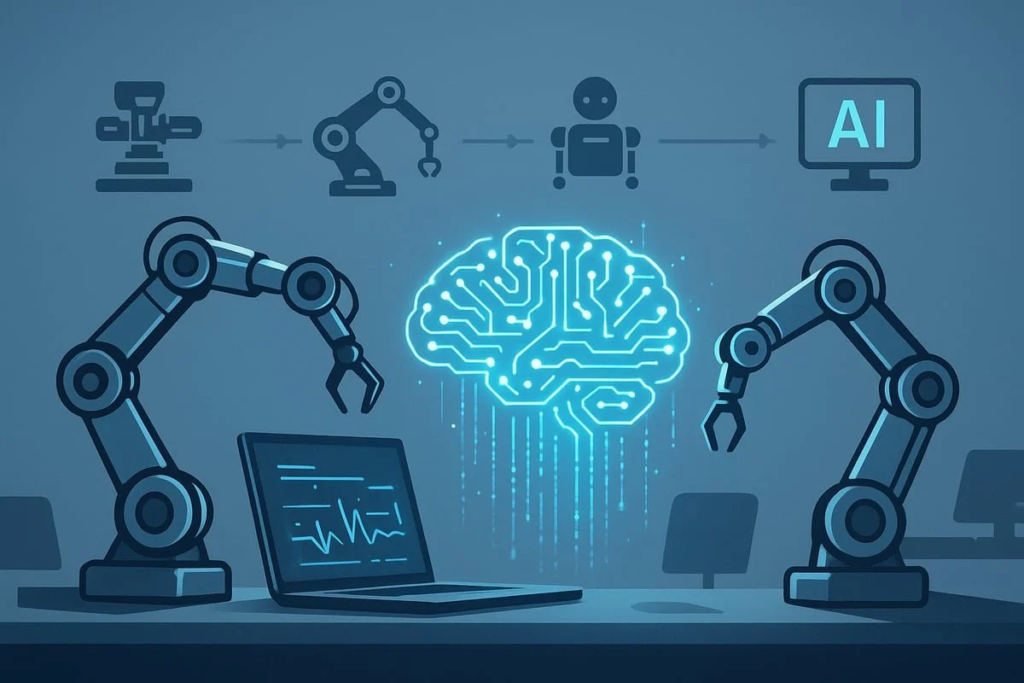
People tend to use the words “AI” and “automation” interchangeably, but they are actually two completely different animals. Mixing them up is like confusing a train with the engineer driving it.
Think of a traditional automated factory arm. It is programmed to turn a specific screw exactly 90 degrees every four seconds. If you accidentally slide a wooden block under that arm instead of a metal car part, it will try to screw into the wood anyway, break itself, and trigger an error code. That is pure automation—fast, precise, but totally blind.
Now, add AI to that same factory arm. The arm is now connected to a camera system running computer vision. It instantly recognizes that the wooden block doesn’t belong there, stops itself, signals a human supervisor, and logs the incident to optimize the conveyor belt line for next time.
When you combine the brute efficiency of automation with the adaptive learning of AI, you get intelligent automation—systems that don’t just execute instructions, but actually react to the messiness of the real world.
Where the Tools are Quietly Running Your Day
You don’t have to look at a high-tech corporate office to see these systems in action. You are likely interacting with them before you’ve even had your first cup of coffee.
- The Morning Commute: When you open a navigation app to check your route to work, a machine-learning algorithm is instantly digesting real-time speed data from thousands of other drivers, historical traffic patterns, and weather reports to predict an accident three miles ahead before you can see it.
- The Media Stream: When you sit on the couch and open a streaming platform, the system isn’t just showing you random popular movies. It is running an algorithmic analysis of your viewing habits—noticing that you tend to watch fast-paced action comedies on Friday nights but slow-paced documentaries on Sunday afternoons—and tailoring its entire interface to match your current psychological state.
- The Office Inbox: Basic administrative friction is slowly being eroded. Your email client automatically categorizes spam, flags emails that look like they require an urgent calendar invite, and drafts predictive text responses that sound eerily like your own voice.
The Industrial Shifts: From Paperwork to Healthcare

The corporate adoption of these tools isn’t just about cutting costs; it’s about shifting human energy away from mind-numbing repetition.
In the Modern Office
For decades, workers have spent countless hours copying data from one spreadsheet to another, manually cross-referencing invoices, and filing expense reports. This is precisely the kind of work that is being automated out of existence. Financial institutions use intelligent algorithms to monitor millions of credit card transactions per second, spotting a bizarre $5 purchase in a foreign country and freezing the card before the customer even realizes their wallet is missing.
In the Medical Ward
In healthcare, the stakes are vastly different. No one wants a robot making life-or-death surgical decisions alone, but AI is proving to be an incredible co-pilot for doctors.
| Application | How It Works | The Human Benefit |
| Diagnostic Assistance | Algorithms scan thousands of MRI images or X-rays, comparing them to global databases of anomalies. | Spots tiny, microscopic tissue changes or early-stage tumors that might escape even an exhausted radiologist’s eye during a late-night shift. |
| Operational Workflow | Automating patient charting, scheduling shifts, and transcription. | Frees up nurses and doctors from hours of paperwork, letting them focus on actual, bedside patient care. |
The Ethical Minefields: Friction, Bias, and Privacy
It would be completely irresponsible to talk about this technological leap without addressing its dark side. The rapid rise of AI has outpaced our legal frameworks, creating serious societal challenges that require urgent attention.
The Problem of Algorithmic Bias: AI models do not think for themselves; they learn by reading the history of human data. If the historical data you feed into an AI hiring system contains human biases—such as favoring resumes from certain demographics over others—the AI will learn that bias, codify it, and scale it up at a terrifying speed. An algorithm doesn’t know what fairness means; it only knows what it has been trained on.
There is also the profound question of privacy. For an AI to be highly personalized, it needs data—your location history, your purchasing habits, your search queries, and your voice prints. Striking a balance between the massive convenience of predictive technology and the fundamental human right to digital privacy is going to be one of the defining political and legal battles of our generation.
The Future Workforce: Future-Proofing Your Career

If repetitive, structured tasks can be automated, what happens to the human workforce? The answer isn’t total unemployment; it is re-skilling.
The historical parallels here are incredibly clear. When the automatic telephone switchboard was invented, thousands of switchboard operators lost their jobs—but the explosion of telecommunications created millions of new careers in network engineering, digital design, and customer service that were previously unimaginable.
To remain competitive in an AI-driven economy, you don’t need to learn how to write complex code. You need to double down on the traits that silicon chips cannot replicate.
- Emotional Intelligence & Empathy: A machine can draft a technically perfect email, but it cannot navigate a delicate office political situation, comfort a grieving client, or understand the unspoken tension in a boardroom.
- Complex Problem-Solving: AI is phenomenal at finding answers to specific questions, but it is terrible at figuring out which questions are actually worth asking in the first place. High-level strategy requires an intuitive understanding of human nature and cultural context.
- Adaptability: The single most critical skill for the next thirty years is the willingness to look at your daily workflow, realize a part of it has been automated, and say, “Great, that means I can use this new tool to free up my time for more interesting, high-value projects.”
FAQ’S
1. What is AI and automation?
AI enables machines to learn and make decisions, while automation performs tasks automatically with minimal human effort.
2. How is AI used in everyday life?
AI is used in virtual assistants, smart devices, navigation apps, online shopping, and personalized recommendations.
3. Can AI and automation improve business productivity?
Yes, they help automate repetitive tasks, reduce errors, and increase efficiency.
4. Will AI replace human jobs completely?
AI will automate some tasks, but human creativity, critical thinking, and leadership remain essential.
5. What are the benefits of AI and automation?
They save time, improve accuracy, reduce costs, and enhance decision-making across many industries.