

AI tools have become part of everyday work.Engineering People use them to write emails, create social media posts, summarize documents, brainstorm ideas, analyze information, learn new subjects, and even plan projects.
But there is one thing that can make a surprisingly big difference in the quality of the results: the way you ask the AI to do something.
That is where prompt engineering comes in.
You may have already noticed this while using an AI chatbot. A short, unclear request can produce a generic answer, while a well-written prompt can give you something much closer to what you actually wanted.
The good news is that prompt engineering is not only for programmers or AI experts. Anyone who regularly works with AI can learn the basics.
This guide explains prompt engineering in simple language and shows you how to create better AI prompts step by step.
What Is Prompt Engineering?
Prompt engineering is the practice of creating clear and useful instructions for an AI system so it can produce a more relevant response.
A prompt is simply what you give the AI as an instruction or question.
For example:
Basic prompt:
“Write about healthy eating.”
More useful prompt:
“Write a 700-word beginner-friendly article about healthy eating. Use simple language, include practical meal ideas, and organize the article with clear headings.”
Both prompts ask for content about healthy eating, but the second one gives the AI much more direction.
That extra information helps the AI understand what you expect.
Prompt engineering is essentially about learning how to communicate with AI more effectively.
Why Is Prompt Engineering Important?
AI can generate impressive results, but it does not automatically know exactly what you have in mind.
Imagine asking a photographer to take a picture without explaining the location, mood, subject, or style. The photographer may still take a good photograph, but it might not match your expectations.
AI prompts work in a similar way.
A strong prompt can help you:
- Get more relevant answers
- Reduce unnecessary information
- Improve writing quality
- Generate better ideas
- Save time when working with AI
- Create consistent results
- Guide the tone and format of responses
- Make complicated tasks easier to manage
Instead of repeatedly correcting an AI response, you can often improve the original prompt.
The Basic Structure of a Good AI Prompt
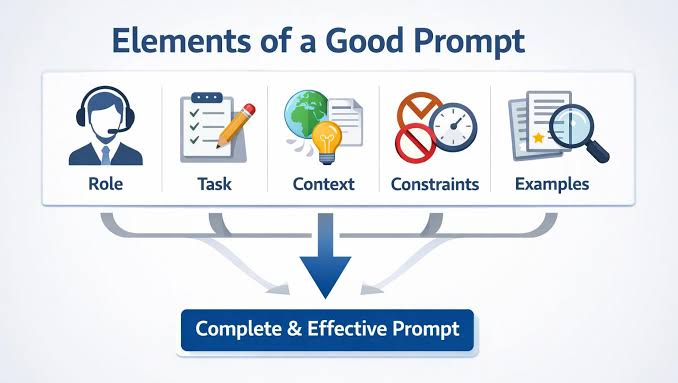
There isn’t one magical formula that works for every situation. However, a useful prompt often contains several important elements.
1. Tell the AI What You Want
Start with the main task.
For example:
“Create a blog outline about home organization.”
This gives the AI a clear direction.
2. Add Context
Context helps the AI understand the situation.
Instead of:
“Write an email.”
Try:
“Write a polite email to a customer explaining that their order will arrive two days later than expected.”
The second version provides a reason and audience.
3. Define the Audience
Tell the AI who will read or use the result.
For example:
“Explain artificial intelligence to someone who has never used an AI tool.”
This encourages the response to stay beginner-friendly.
4. Specify the Format
If you want a particular structure, say so.
You might request:
- Bullet points
- A table
- Step-by-step instructions
- An article
- An email
- A checklist
- A social media caption
- A short summary
For example:
“Explain the topic in five bullet points followed by three practical examples.”
5. Mention the Tone
Tone can completely change the feel of a response.
You can ask for:
- Friendly
- Professional
- Casual
- Educational
- Conversational
- Persuasive
- Concise
- Formal
For example:
“Write this in a warm, conversational tone for first-time homeowners.”
6. Add Useful Limits
Specific limits can make the output easier to use.
Examples include:
“Keep it under 500 words.”
“Use short paragraphs.”
“Give me 10 ideas.”
“Explain each step in two or three sentences.”
The key is to provide constraints that actually matter for your task.
A Simple Prompt Formula for Beginners

If you’re new to prompt engineering, start with this simple structure:
Task + Context + Audience + Format + Tone + Requirements
For example:
“Write a beginner-friendly guide about indoor plants for apartment residents. Use simple language, include 10 easy-care plants, explain basic care tips, and organize the article with clear headings.”
This prompt tells the AI:
- Task: Write a guide
- Topic: Indoor plants
- Audience: Apartment residents
- Level: Beginner-friendly
- Format: Guide with headings
- Requirement: Include 10 plants and care tips
You don’t have to include every element in every prompt. Use what is useful for the task.
Before and After: Improving a Prompt

Let’s look at how a basic prompt can become more effective.
Weak Prompt
“Give me marketing ideas.”
The AI has very little information to work with.
Better Prompt
“Give me 15 marketing ideas for a small online fashion store.”
Now the AI knows the business type.
Stronger Prompt
“Give me 15 affordable marketing ideas for a small online fashion store targeting women aged 18–35. Include a mix of Instagram, email, content marketing, and customer referral ideas. Explain each idea in one or two sentences.”
Now the task is much clearer.
This is one of the easiest lessons in prompt engineering: specific instructions generally give the AI more useful direction.
Use Examples When You Want a Specific Style

One of the most useful prompt techniques is showing the AI an example.
Suppose you want product descriptions with a particular structure.
Instead of simply saying:
“Write product descriptions in this style.”
You can provide an example and explain what you want the AI to follow.
For instance:
“Here is an example product description. Follow its structure, sentence length, and friendly tone when writing the new descriptions.”
Examples can help the AI understand patterns that are difficult to describe with instructions alone.
This approach is often called few-shot prompting when you provide one or more examples for the model to follow.
Ask AI to Break a Complex Task Into Steps

Large tasks can become easier when you divide them into smaller parts.
Instead of:
“Create a complete business plan.”
Try:
“First create a business-plan outline. Then identify the target customer. Next suggest marketing channels. Finally create a simple first-year action plan.”
Breaking a task into stages can make the process easier to review and refine.
It also gives you opportunities to correct the direction before moving further.
Use Role-Based Instructions Carefully
Another popular prompting technique is asking the AI to approach a task from a particular professional perspective.
For example:
“Act as an experienced travel editor and create a weekend itinerary for first-time visitors.”
Or:
“Approach this as a beginner-friendly technology tutor.”
This can help establish the perspective, audience, and style you want.
However, the role itself is not magic. The rest of the prompt still matters.
A detailed task with useful context is usually more valuable than simply saying, “Act as an expert.”
Ask for the Right Level of Detail

One common problem with AI responses is getting either too much information or not enough.
You can guide the level of detail directly.
For a quick answer:
“Answer in three concise bullet points.”
For a detailed explanation:
“Explain this for a beginner and include examples for each major concept.”
For a practical guide:
“Give me step-by-step instructions and mention common mistakes to avoid.”
Being clear about the depth you want can make the response much easier to use.
Prompt Engineering for Writing

AI is widely used for writing, but vague prompts can produce generic content.
Instead of:
“Write a blog about skincare.”
Try:
“Write a beginner-friendly skincare guide for people creating their first daily routine. Cover cleansing, moisturizing, sunscreen, and basic product selection. Use a conversational tone, short paragraphs, and practical examples.”
For SEO content, you can also specify:
- Target keyword
- Search intent
- Audience
- Article length
- Heading structure
- FAQs
- Meta description
- Internal linking suggestions
However, avoid stuffing every possible instruction into one enormous prompt. Give the AI the information that actually affects the result.
Prompt Engineering for Research

AI can help organize research, but you should still verify important facts independently.
A useful research prompt might be:
“Create a comparison framework for electric cars. Include purchase price, charging, range, maintenance, practicality, and key disadvantages. Present the information in a simple table.”
You can then use the framework to collect and evaluate information.
For current facts, prices, regulations, statistics, or breaking developments, make sure the information is checked against reliable up-to-date sources.
Prompt Engineering for Summarizing

When summarizing a long piece of information, tell the AI exactly what kind of summary you need.
For example:
“Summarize this article in 10 bullet points. Focus only on the main arguments and practical takeaways.”
Or:
“Create a short executive summary for a busy manager. Include the problem, key findings, recommendations, and next steps.”
The same source can produce very different summaries depending on the instructions.
Prompt Engineering for Brainstorming
AI can be useful when you’re stuck for ideas.
Instead of:
“Give me blog ideas.”
Try:
“Give me 20 blog ideas about home organization for small apartments. Focus on practical problems people face every day. Avoid generic topics and include a mix of beginner guides, checklists, and problem-solving articles.”
You can also ask AI to group ideas into categories.
For example:
“Group these ideas into beginner, intermediate, seasonal, and problem-solving topics.”
That turns a large list into something easier to work with.
Prompt Engineering for AI Images

The same basic principle applies to image-generation prompts.
A useful image prompt can describe:
- Main subject
- Setting
- Composition
- Lighting
- Mood
- Perspective
- Style
- Aspect ratio
For example:
“Create a bright editorial-style photograph of a cozy modern living room with neutral furniture, indoor plants, natural window light, and a clean uncluttered composition.”
The more visual direction you provide, the easier it is to guide the image toward your intended result.
Common Prompt Engineering Mistakes
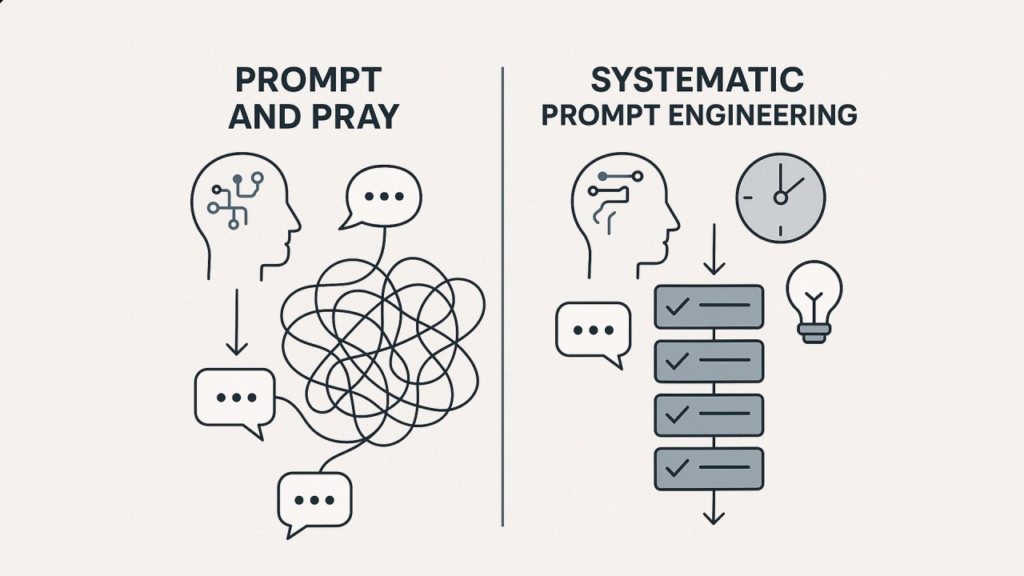
Learning what not to do is just as useful as learning what works.
Being Too Vague
“Make this better” doesn’t tell the AI what better means.
Explain what you want changed.
For example:
“Make this paragraph easier to read, more conversational, and suitable for a beginner audience.”
Giving Conflicting Instructions
If you ask for a detailed 2,000-word article and then say “keep the answer extremely short,” the instructions compete with each other.
Keep your requirements consistent.
Adding Too Many Unnecessary Instructions
More instructions do not automatically mean a better result.
A prompt packed with irrelevant details can make the task harder to follow.
Focus on what actually matters.
Expecting One Prompt to Be Perfect
Prompting is often an iterative process.
You might start with a basic instruction, review the response, and then refine it.
Try:
“Make the introduction more conversational.”
“Remove repetitive points.”
“Add practical examples.”
“Make the explanation easier for beginners.”
Small follow-up instructions can dramatically improve a draft.
How to Improve an AI Response
When the first response isn’t right, don’t immediately start over.
Tell the AI what needs to change.
For example:
“Keep the same structure, but make the language more natural and reduce repetitive wording.”
Or:
“Keep the main information but shorten each section and add practical examples.”
You can also ask:
“What information is missing from this answer?”
Then use the feedback to create a stronger version.
Advanced Prompt Engineering Techniques
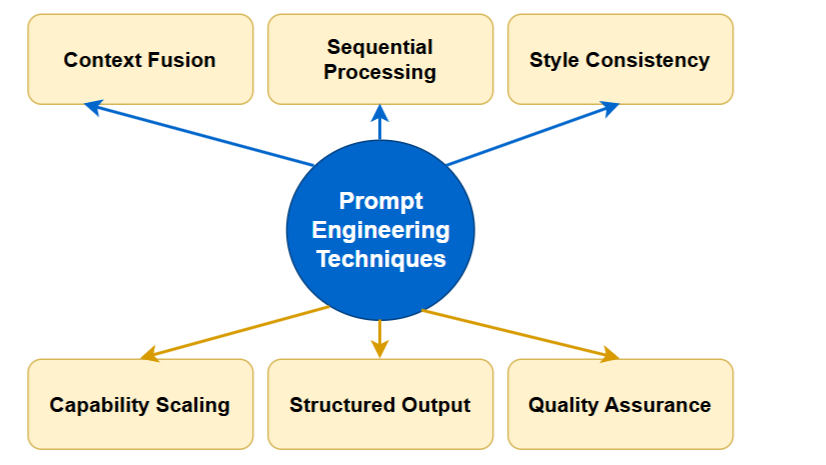
Once you’re comfortable with basic prompting, you can experiment with more advanced techniques.
Zero-Shot Prompting
You give the AI a task without examples.
Example:
“Classify these customer comments as positive, negative, or neutral.”
Few-Shot Prompting
You provide examples before asking the AI to perform the task.
This is useful when you want a particular format or classification pattern.
Structured Output
You can ask for a specific structure.
For example:
“Return the information using these fields: Title, Audience, Difficulty, Estimated Time, and Materials.”
This is especially useful when working with large amounts of information.
Iterative Prompting
Instead of trying to get everything in one response, improve the result through several rounds.
For example:
- Create an outline.
- Review the outline.
- Expand each section.
- Improve the introduction.
- Check for repetition.
- Create the final version.
This workflow can be much easier to control.
How to Write Better Prompts for Everyday Work

Prompt engineering becomes especially useful when you turn common tasks into repeatable workflows.
For example, you could create a reusable prompt for meeting notes:
“Turn these meeting notes into a clear summary. Organize the response into key decisions, action items, responsible people, deadlines, and unanswered questions.”
Or an email prompt:
“Rewrite this email so it sounds professional, friendly, and concise. Keep the original meaning and remove unnecessary repetition.”
Or a learning prompt:
“Teach me this topic as a beginner. Start with the basic concept, then explain three examples and finish with a short quiz.”
These reusable prompts can save time because you don’t have to reinvent the instructions every time.
A Practical Prompt Checklist

Before sending an important prompt, quickly check:
- Did I clearly explain the task?
- Did I provide enough context?
- Did I identify the audience?
- Did I mention the desired format?
- Did I explain the tone if it matters?
- Did I include important constraints?
- Did I provide an example when necessary?
- Are my instructions consistent?
- Have I avoided unnecessary information?
If the answer is yes to most of these, you probably have a solid starting prompt.
10 Prompt Templates You Can Reuse
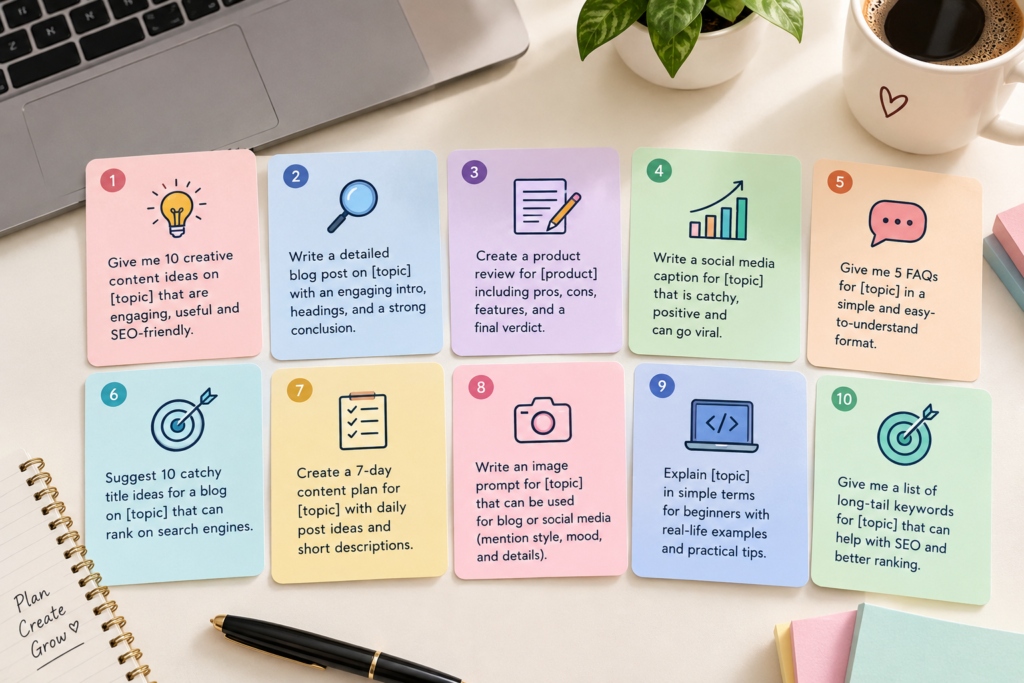
1. Writing
“Write a [type of content] about [topic] for [audience]. Use a [tone] tone and include [key points]. Keep it around [length].”
2. Learning
“Explain [topic] to me as a beginner. Use simple language, practical examples, and finish with five questions to test my understanding.”
3. Summarizing
“Summarize the following information in [number] bullet points. Focus on the main ideas, important facts, and practical takeaways.”
4. Brainstorming
“Give me [number] ideas for [topic]. Focus on [audience/problem] and avoid generic suggestions.”
5. Rewriting
“Rewrite the following text to make it [clearer/more conversational/professional]. Keep the original meaning and remove unnecessary repetition.”
6. Planning
“Create a step-by-step plan for [goal]. Include priorities, suggested actions, and potential challenges.”
7. Comparison
“Compare [A] and [B] based on [criteria]. Present the result in a simple table and explain which option may suit [audience].”
8. Productivity
“Help me organize these tasks into urgent, important, and low-priority categories. Suggest a practical order for completing them.”
9. Content Ideas
“Give me [number] content ideas about [topic] for [audience]. Include a mix of educational, practical, and problem-solving topics.”
10. Editing
“Review this text for clarity, grammar, repetition, and flow. Suggest improvements while keeping the original voice.”
The Future of Prompt Engineering
As AI systems become easier to communicate with, prompt engineering is likely to become less about memorizing complicated formulas and more about clear thinking and good communication.
People who understand how to describe a problem, provide useful context, define an outcome, and evaluate an AI response will have an advantage across many types of work.
The tools will continue to change, but the basic skill remains useful: knowing what you want and explaining it clearly.
FAQ’S
1. What is prompt engineering?
Prompt engineering is the practice of writing clear instructions to get more useful results from AI tools.
2. How can I write a better AI prompt?
Clearly explain the task, add relevant context, mention the audience, and specify the format or tone you want.
3. Is prompt engineering difficult for beginners?
No. Beginners can start with simple instructions and improve their prompts through practice.
4. Why are examples useful in AI prompts?
Examples help AI understand the style, structure, format, or type of response you expect.
5. What is iterative prompting?
Iterative prompting means improving an AI response through follow-up instructions instead of expecting the first answer to be perfect.