
Buyer attention is allocated, not available. The average B2B professional moves through dozens of content surfaces daily: feeds, inboxes, AI-generated Marketing summaries, and podcast queues. The brands that reach them show up with precision at the right moment. Volume without relevance is overhead. Here are top ten marketing strategies built for how buyers actually behave in 2026.
The underlying shift is simple. Distribution is no longer scarce. Interpretation is. Buyers are filtering harder, skipping faster, and rewarding only what aligns with their immediate context. Strategy, therefore, becomes less about reach and more about timing, fit, and learning velocity.
1. Run Creative Like an Engineering Team

Creative is a testable variable. Hook testing, format rotation, and copy iteration on short cycles generate a compounding signal that reshapes how the brand communicates over time. The marketing strategy is building a creative system that learns and improves with each cycle.
This looks less like campaign planning and more like sprint cycles. Hypothesis, deploy, measure, refine. Over time, patterns emerge across audiences and formats. Certain hooks pull attention faster. Certain narratives hold it longer. That learning compounds into creative intuition that is backed by data, not opinion.
The advantage is not just better ads. It is faster convergence on what the market actually responds to.
2. Behavioral Segmentation Over Demographic Targeting
Job title and company size are static proxies for behavior that is actually dynamic. A CFO researching a new category on a Saturday morning is in a completely different mental mode than the same person scanning LinkedIn between meetings. Behavioral segmentation built on real-time signals like content consumption patterns, search query specificity, and engagement recency puts the right message in front of the right mental context.
This shift changes how segments are defined. Instead of “enterprise CFOs,” you are working with “high-intent researchers in evaluation mode” or “early-stage explorers comparing categories.” Messaging aligns with mindset, not identity.
The result is higher resonance. The same audience, when approached through behavior, starts to feel like multiple distinct entry points.
3. Contextual Advertising Is the Targeting Layer That Scales Clean
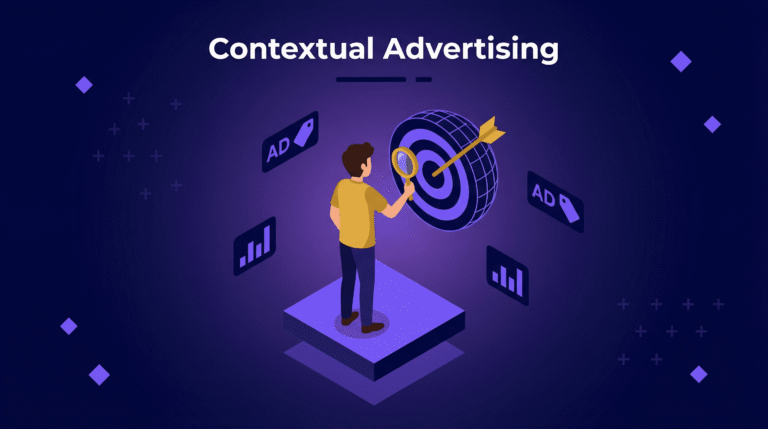
With third-party cookies largely deprecated, contextual advertising has matured into a primary targeting layer. Placing messages alongside content that is thematically aligned with the product reaches a buyer who is already in the right headspace. Context is an intent signal, and it requires no personal data infrastructure to execute at scale.
The effectiveness comes from alignment, not intrusion. A buyer reading about supply chain resilience is far more receptive to a logistics platform than one being followed across the internet by retargeting pixels.
It also simplifies compliance. Clean targeting without dependency on personal identifiers reduces regulatory risk while maintaining performance.
4. Close the B2C Experience Gap in B2B
The same person who gets instant support and a frictionless checkout on their personal apps is the one evaluating your enterprise product through a slow response window and a gated demo. Self-serve evaluation paths, pricing transparency, and interactive product tours that let a buyer reach conviction before talking to sales are table stakes in 2026, and the B2B brands closing this gap are seeing it in pipeline velocity.
This is not about copying consumer UX blindly. It is about respecting buyer time. Faster access to information reduces friction and builds trust earlier in the journey.
When buyers can validate fit on their own terms, sales conversations start at a higher level. Less explaining, more decision-making.
5. Async Video Owns the Middle of the Funnel

Async video sits between a written case study and a live conversation, and for buyers deep in evaluation, it is the format that moves them. Personalized video outreach, recorded product walkthroughs, and founder-narrated explainers carry trust signals that text delivers more slowly, and they respect the buyer’s schedule.
The strength of async video is nuance. Tone, clarity, and intent travel better through voice and visuals than through text alone. A complex product becomes easier to grasp when demonstrated rather than described.
It also scales human presence. One well-crafted walkthrough can serve hundreds of buyers without losing clarity or context.
6. Marketing Ops Is a Growth Lever
The infrastructure underneath a marketing strategy determines how fast it can learn and adapt. Companies with clean digital marketing ops, tight data flow, precise audience segmentation, and automated lead routing can run a new segment test in hours. The gap in execution speed between a well-architected ops stack and a less connected one shows up in time-to-insight, which is what determines how quickly a growth opportunity gets captured.
Ops is no longer back-office. It is front-line leverage. When systems talk to each other, insights compound faster. When they don’t, teams spend time reconciling data instead of acting on it.
Speed here is strategic. The faster you learn, the faster you win.
7. Treat Trend Velocity as a Risk Variable
The window between a format emerging and becoming saturated has compressed to months. Brands that move early on a new channel or creative format capture disproportionate attention at low cost. Building a formal process for identifying, testing, and scaling emerging formats before they peak is a structural advantage, the same way a finance team treats currency risk or supply chain lead times.

This requires discipline. Not every trend deserves investment. The edge comes from filtering quickly, testing cheaply, and scaling only what shows early signal.
The companies that institutionalize this process avoid both extremes. They are neither late adopters nor reckless chasers.
Content Experiences: The Natural Nurturing Programs that Drive Sales
Campaigns that stop and start and quarterly themes are no longer effective. If your buyers take 6 months or more to make a decision and your campaign runs for one quarter, how many sales will you make? Rather than providing marketing programs on your timeline, high-performance content marketing must be aligned to the buyers journey. But – it also must allow for non-linear access, allowing your buyers to choose their own “adventure.”
Share a serial story that builds your buyer’s confidence and momentum. Nurturing is business storytelling at its finest—from generating awareness of the problem and mitigating risk to making a purchase decision. And it’s important to understand that “nurturing” doesn’t just mean via an email campaign. It applies to every interaction on every channel. That’s where storylines help you shine.
Relevant Buyer-Driven Experiences Bring Big Advantages
Consistency of experience is hugely important. Even more so when buyers are in control.

This means whether your buyer or customer is in a nurture stream, visits your website, reads your blog, follows you on social media, listens to your podcast, or attends your webinars or user events, the story must resonate with every interaction.
If it doesn’t, they’ll be gone in a click. This doesn’t mean saying the same thing, in the same way, repeatedly.
When your personas give you the foundation for the buyer-to-customer story, you have what you need to create “chapters” in infinite ways that resonate powerfully along with each context change buyers’ experience as they learn more.
Your brand gains strength by creating memory structures that build mental availability once the problem you solve becomes a priority. Demand follows naturally. And so does your place on the Day 1 list.
Platform Selection Based on Audience Behavior

Prioritize channels where your target audience actively engages rather than chasing new platform trends. Allocate 60% of your budget to proven high-performing channels and reserve 40% for emerging opportunities. This balance ensures stable performance while allowing experimentation with innovative approaches.
Test new platforms with small budget allocations before scaling successful experiments. The social media landscape continues evolving rapidly, and early adoption can provide competitive advantages. However, premature scaling without proof of concept wastes resources and dilutes overall campaign effectiveness.
Consider generational preferences when selecting platforms, but avoid oversimplification. While trends exist, individual behavior varies significantly within age groups. Use data-driven insights to guide platform selection rather than relying solely on demographic assumptions.
FAQ’S
1. What is marketing and why is it important?
Marketing is the process of promoting products or services, reaching potential customers, and building awareness of a brand. It helps businesses attract new customers, increase sales, build trust, and maintain long-term relationships with their audience.
2. What are the main types of marketing?
The main types include digital marketing, content marketing, social media marketing, email marketing, search engine optimization (SEO), influencer marketing, affiliate marketing, and traditional marketing such as print and television advertising.
3. How can a business create an effective marketing strategy?
A business should first identify its target audience, understand customer needs, set clear marketing goals, choose the right channels, create valuable content, and regularly measure campaign performance to improve results.
4. Why is digital marketing important for businesses?
Digital marketing allows businesses to reach a wider audience through search engines, social media, websites, email, and online advertising. It can also provide measurable results and help businesses connect with customers more effectively.
5. How can businesses measure marketing success?
Marketing success can be measured using metrics such as website traffic, leads, conversion rates, customer engagement, sales, return on investment (ROI), and customer acquisition costs. These metrics help businesses understand which strategies are working.