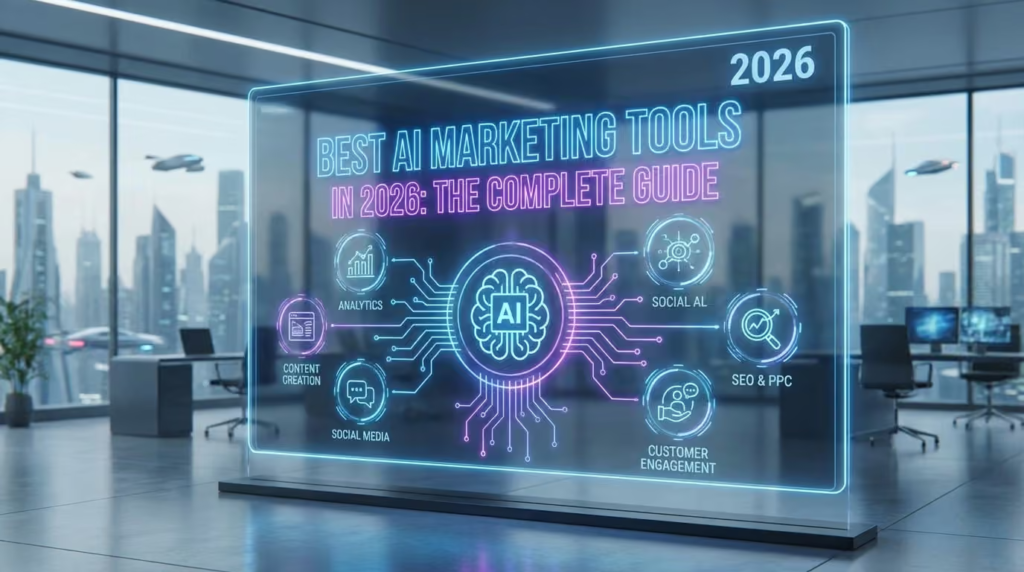
Marketing has undergone a massive shift. Marketers no longer need to rely solely on manual research, endless spreadsheets, or manual content production to reach their audiences. Artificial intelligence is now integrated directly into daily workflows, assisting with campaign strategy, content creation, performance analytics, and task automation.
VertexPlus Technologies
However, having access to these platforms does not guarantee success. The real competitive advantage lies in knowing which tasks to automate, selecting the right platforms, and retaining human creativity and critical judgment where it matters most.
What Are AI Marketing Tools?
AI marketing tools are applications powered by machine learning algorithms that assist teams in executing campaigns faster and making data-informed decisions.
GWI
These platforms handle tasks across the entire customer lifecycle. A marketer might start the morning using AI to generate ad copy variations, analyze customer behavior patterns in the afternoon, and rely on automated workflows to nurture new leads by the evening. AI is designed to support a broader marketing strategy, not serve as a replacement for strategy itself.
Pushwoosh+ 1
Why AI Is Essential in Modern Marketing

Marketing teams manage a constantly growing list of channels and responsibilities: writing blog posts, managing social accounts, reviewing SEO data, tracking customer inquiries, and building email workflows.
Pushwoosh
AI significantly reduces the burden of repetitive, manual labor. Modern marketing platforms focus heavily on automating routine execution, giving human marketers more time to dedicate to high-level strategy, creative direction, brand voice, and customer relations.
Marketer Milk+ 1
Content Creation and Copywriting
Content generation is one of the most widespread applications of AI in marketing. AI writing assistants allow teams to quickly brainstorm ideas, build detailed article outlines, rewrite existing copy, and generate multi-channel messaging variations.
Pushwoosh
Rather than spending hours staring at a blank page, a copywriter can prompt an AI tool to produce a dozen headline options and select the strongest concept. However, publishing raw AI text without human review often leads to flat, generic copy. Human editing is necessary to ensure accuracy, add real-world examples, and infuse the distinct personality of your brand.
SEO and Content Optimization

Modern search engine optimization requires a clear understanding of user search intent, competitor strategies, topical authority, and technical site structure.
The Smarketers
AI-driven SEO platforms evaluate top-ranking pages, highlight content gaps, and suggest semantic keywords to improve search visibility. Additionally, marketers now track how their brands appear within generative AI search engines and answer engines. AI tools provide useful data and guidelines, but strategy should still be guided by genuine value for human readers rather than strict algorithm optimization.
The Smarketers+ 1
Social Media Marketing
Managing multiple social platforms demands tailored messaging, frequent updates, and quick community engagement.
AI tools assist social media managers by drafting captions, adapting one core piece of long-form content into short posts for different platforms, and organizing publishing calendars. Social channels rely heavily on authenticity, so reviewing and refining automated posts ensures communications remain personal and engaging.
Jotform+ 1
Email Marketing and Personalization
Email platforms use AI to move past basic bulk messaging and deliver hyper-personalized experiences.
By evaluating past purchase history, site activity, and engagement patterns, AI helps marketers segment lists dynamically and trigger automated emails at optimal times. An online store, for example, can automatically send different recommendations to a loyal customer versus a first-time visitor. The goal is not simply sending more emails, but delivering timely, relevant messages.
VertexPlus Technologies
Customer Experience and Personalization

Consumers expect brand interactions to align with their specific interests. Generic, broad marketing messages are increasingly ineffective.
VertexPlus Technologies
AI platforms analyze real-time user behavior to serve tailored product recommendations, dynamic website content, and targeted offer messaging. While hyper-personalization improves conversion rates, brands must maintain strong data privacy practices and handle user data responsibly.
VertexPlus Technologies+ 1
Predictive Analytics and Insights
Interpreting massive datasets manually is time-consuming and often misses subtle trends. AI analytics platforms scan performance metrics across channels to highlight actionable insights automatically.
VertexPlus Technologies
If an advertising campaign receives high click volume but poor conversion rates, AI tools can flag the drop-off immediately. This enables marketers to quickly test adjustments to landing pages, messaging, or pricing models. AI identifies the underlying data patterns, leaving marketers to focus on tactical solutions.
Workflow Automation
Connecting disjointed software systems keeps data flowing smoothly across your entire marketing organization.
Using workflow automation platforms, a single customer action—such as filling out a contact form—can automatically create a CRM profile, assign a lead score, send a tailored welcome email, and notify a sales representative. Automation minimizes manual task handoffs and creates consistent customer journeys.
Pushwoosh
AI Marketing Capabilities Overview
| Marketing Function | Key AI Capability | Example Platforms | Ideal Use Case |
|---|---|---|---|
| Content Generation | Writing, ideation, draft creation | ChatGPT, Claude, Jasper | Blog drafts, ad copy, brainstorms |
| SEO & Optimization | Keyword research, SERP analysis | Semrush, Surfer SEO, Clearscope | Strategic organic search content |
| Social Media | Caption creation, content recycling | Sprout Social, Hootsuite, SocialBee | Multi-channel social execution |
| Email & Lifecycle | Predictive send times, segmentation | ActiveCampaign, Klaviyo, Pushwoosh | Targeted customer communications |
| CRM & Data | Customer unified profiles, insights | HubSpot, Salesforce Customer 360 | Lead tracking, enterprise data management |
| Visual Design | Asset generation, layout adjustments | Canva AI, Midjourney, Figma AI | Social assets, ad creative variants |
| Workflow Automation | Cross-app triggers and tasks | Zapier, Gumloop | Eliminating repetitive admin work |
How to Choose the Right AI Tools

Subscribing to too many software platforms leads to fragmented workflows and unnecessary expenses. Focus on solving clear operational bottlenecks before adopting new tools.
- Identify primary pain points: If content output is slow, invest in writing tools. If user data is disorganized, prioritize an AI-enabled CRM. GWI
- Evaluate integration capacity: Ensure new software connects easily with your current tech stack.
- Verify privacy standards: Check how platforms handle proprietary customer data and corporate information.
- Assess ease of adoption: A simple tool your team uses daily yields better ROI than an overly complex platform.
Common Pitfalls to Avoid
- Publishing without verification: AI can generate incorrect facts or unverified assertions. Human fact-checking remains mandatory. VertexPlus Technologies
- Over-automation: Replacing human interaction entirely can make brand communications feel cold and generic.
- Data security risks: Avoid entering sensitive customer data or private company strategy into public tools that utilize inputs for training data.
- Focusing on volume over results: Producing twice as many low-quality posts does not translate to higher engagement or sales revenue.
Balancing Technology and Human Judgment
The most effective marketing strategies rely on a clear division of labor between AI execution and human oversight.
- Let AI handle: Large-scale data processing, drafting initial content options, scheduling tasks, and identifying performance trends. Pushwoosh
- Keep humans focused on: Defining brand identity, managing client relationships, reviewing creative output, and making strategic choices.
When AI handles administrative and repetitive burdens, marketers are free to focus on original, compelling storytelling that resonates with real people.
FAQs
1. What are AI marketing tools?
AI marketing tools use artificial intelligence to help with content creation, customer insights, campaign planning, personalization, analytics, and automation.
2. How can AI improve marketing campaigns?
AI can reduce repetitive work, analyze marketing data, personalize campaigns, and help teams create content and campaign variations more efficiently.
3. Are AI marketing tools useful for small businesses?
Yes. Small businesses can use AI tools for content, design, social media, email marketing, customer support, and workflow automation without building large marketing teams.
4. Can AI replace marketing professionals?
No. AI can assist with many marketing tasks, but human judgment is still important for strategy, creativity, brand voice, accuracy, and final decisions.
5. How should I choose an AI marketing tool?
Choose a tool based on the specific marketing problem you want to solve, such as SEO, content creation, social media, analytics, or automation.