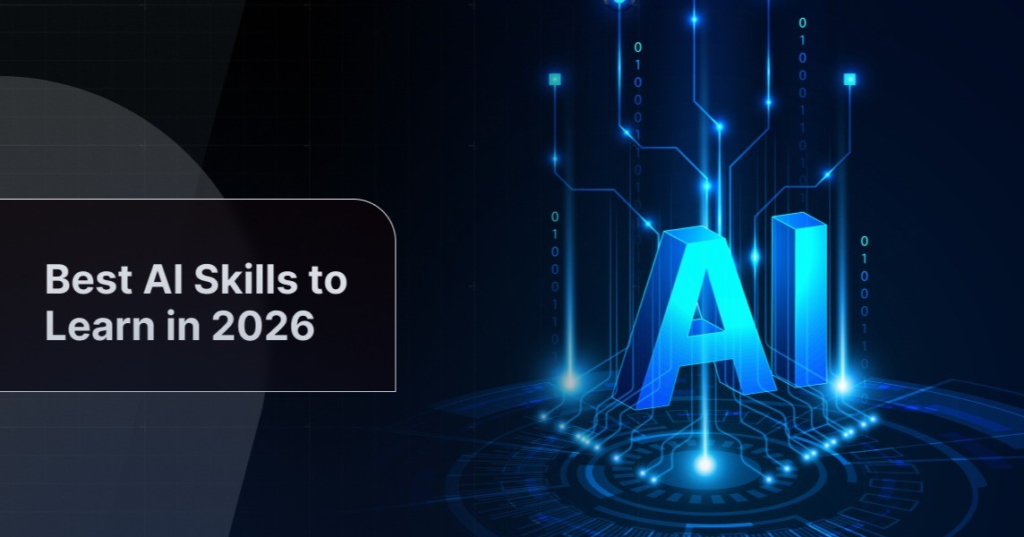
If you turn on the news or open LinkedIn today, you’d think you need a double PhD.The Most In-Demand AI Skills in computer science just to survive the workplace. Everywhere you look, someone is proclaiming that AI is either going to take your job by next Tuesday or make you a millionaire by Friday.
The reality is much quieter—and a lot more practical.
By now, the initial gold rush and viral hype around AI have settled down. We’re no longer just playing with shiny chatbot demos; companies are trying to make this stuff actually work in the real world. And that transition has exposed a massive gap: most organizations don’t need more AI hype—they need people who know how to use these tools without breaking things.
Whether you write code, manage projects, run marketing campaigns, or take care of patients, getting comfortable with AI isn’t about learning how to build a brain from scratch. It’s about building a toolkit that keeps you adaptable.
The “Hard” Tech Stuff (That’s Cheaper and More Accessible Than You Think)

You don’t have to be a math genius to pick up the technical foundations of modern AI. In fact, most of the software ecosystem is built to make this stuff as easy to grab as building blocks.
AI Skills Python & The Data Pipeline
If AI has an official native language, it’s still Python. Not because it’s fancy, but because it’s simple. It reads almost like plain English.
- The Core Stack: You don’t need to master everything, but getting familiar with libraries like Pandas and NumPy (for shuffling numbers around), Scikit-learn (for standard machine learning), and PyTorch (for the heavy neural-network stuff) will give you a massive edge.
- Data Literacy: Here’s a dirty secret of the tech world: 80% of “AI work” is just cleaning up messy spreadsheets and making sure bad data doesn’t poison the system. If you know how to pull, clean, and make sense of raw data, you’re already halfway there.
AI Skills Machine Learning & Neural Networks
You don’t need to write the algorithms from scratch, but you do need to understand the mechanics under the hood:
- Supervised vs. Unsupervised: Knowing when a model needs labeled examples to learn, and when it can just find patterns on its own.
- Natural Language Processing (NLP) & Vision: Understanding how machines parse text and process images helps you spot their blind spots—like when a translation model misses local slang, or a vision system gets confused by bad lighting.
AI Skills The Everyday AI Toolkit (What Matters for Non-Coders)
You don’t need a line of code to be extremely dangerous (in a good way) with modern AI tools.
  [ OLD WAY: THE BRUTE-FORCE SLOG ]           [ NEW WAY: THE SMART HYBRID ]
  • Drafting everything from blank pages       • Generating rough outlines in seconds
  • Manual data entry & repetitive tasks      • Automated workflows running in background
  • Guessing what customer data means         • Quick pattern spotting & instant summaries
  • Hours spent digging for information        • Conversational search & direct answers
AI Skills Prompting Is Just Clear Communication
People love to make “Prompt Engineering” sound like dark magic. It’s not. It’s just giving clear, specific instructions to a very fast, very literal assistant.
- Context is everything: The difference between a useless AI answer and a brilliant one usually comes down to whether you gave the model the right background, persona, and boundaries.
- Output Evaluation: The real skill isn’t making the AI talk—it’s having the judgment to spot when it’s making things up or giving you boring, generic fluff.
AI Skills Automation & Workflow Design
The people saving 10 to 15 hours a week right now aren’t writing code—they’re connecting tools together.
- No-Code Automation: Learning how to hook platforms like Zapier, Make, or Microsoft Power Automate into AI models means you can automate the soul-crushing parts of your job (like copying data between apps, organizing customer feedback, or drafting routine emails).
AI Skills The Human Core (Why You Won’t Be Replaced)

Here’s the thing a lot of tech blogs forget to tell you: AI Skills AI is remarkably bad at being human.
It can spit out 500 pages of text in three seconds, but it doesn’t know if any of it matters. It has no taste, no ethics, and no understanding of office politics or human emotion. That’s where you come in.
- Critical Thinking: Treat AI outputs like a draft from a brand-new intern—fast, energetic, but prone to silly mistakes. You are the editor-in-chief.
- Ethical Judgment: As these systems touch more of daily life, knowing how to spot bias, protect private customer data, and use AI responsibly isn’t just nice to have—it’s a legal and professional requirement.
- Translating “Tech” to “Human”: If you can sit in a room with engineers, understand what the tech can do, and then explain it simply to an executive or client, you will never be out of a job.
How to Actually Get Started

Don’t buy a $2,000 course, and don’t try to read a textbook cover-to-cover. AI Skills The best way to learn is by doing real things in the open.
- Pick One Annoying Task: Find something boring you do every week—summarizing long PDFs, organizing meeting notes, categorizing support emails—and figure out how to solve it with an AI tool.
- Build a Small Portfolio: A fancy certificate on your profile is fine, but a link to a small project you built, a workflow you automated, or a dataset you analyzed will beat a piece of paper every single time.
- Stay Curious, Stay Grounded: The tools will change next month, and new models will drop next year. Don’t worry about learning every single brand name. Focus on the core principles: garbage in, garbage out; test everything; and use the tech to free up space for real human thinking.
Conclusion
Artificial Intelligence is reshaping the future of work, and the professionals who adapt early will have the greatest opportunities. AI Skills While technical skills such as machine learning, Python, deep learning, and NLP remain important, the AI workforce of 2026 also values prompt engineering, automation expertise, ethical awareness, communication, and critical thinking.
The key to success is not mastering every AI discipline at once but developing a strong foundation and continuously building practical experience. Whether you are a student, freelancer, entrepreneur, or experienced professional, investing in AI skills today can create significant advantages for the future.
The demand for AI talent shows no signs of slowing down. By learning the most in-demand AI skills in 2026, you position yourself to thrive in one of the most exciting and rapidly evolving industries in the world.
FAQ’S
1.What is the most in-demand AI skill in 2026?
Generative AI, Prompt Engineering, Machine Learning, and AI Automation are among the most sought-after AI skills in 2026.
2.Do I need coding knowledge to learn AI?
Not necessarily. Many AI tools are designed for non-technical users, although learning Python can significantly expand your opportunities.
3.Which programming language is best for AI?
Python remains the most popular and widely used programming language for artificial intelligence and machine learning.
4.How long does it take to learn AI?
Basic AI skills can be learned within a few months, while advanced expertise in machine learning and deep learning may take one to two years of dedicated study.
5.Is AI a good career choice in 2026?
Yes. AI continues to be one of the fastest-growing career fields, offering excellent job opportunities, competitive salaries, and long-term growth potential.