We have all been there. You spend weeks pouring your heart, soul, and hard-earned money into building a beautiful, flawless website. You pick the perfect color scheme, write pristine copy, upload gorgeous high-resolution images, and finally hit that shiny “Publish” button. Then… absolute silence. Days turn into weeks, and your visitor counter barely moves past zero. It feels like you built a stunning, world-class retail store in the middle of a completely deserted desert where nobody can see it.
In our fast-moving digital world of 2026, simply putting a website on the internet is no longer enough to survive. Millions of fresh articles, product listings, and landing pages are uploaded to the web every single hour.
Trying to get noticed in this massive tidal wave of digital noise can feel completely hopeless.
Thankfully, you don’t have to leave your online visibility to random luck. There is a deeply calculated, human-centric system that acts like a massive digital highway, directing herds of highly interested people straight to your front door.
This system is called Search Engine Optimization (SEO). Mastering it isn’t about learning complex computer programming or trying to trick a machine algorithm. It is about understanding how everyday people search for answers and making sure your digital hub is ready to serve them. Let’s dive into the foundational pillars of search strategy to unlock sustainable, long-term organic growth for your brand.
What Is SEO?
At its deepest core, Search Engine Optimization is the deliberate process of tuning your website’s pages so that search platforms like Google can easily read your content, understand its value, and confidently recommend it to users. Think of a search engine like a hyper-organized digital librarian. When someone walks in and asks a question, the librarian’s entire job is to scan the library and hand over the single most accurate, helpful, and beautifully written book available on that specific topic through a contextual ranking index.
[Legacy Search Era] ──► Text Matching ──► Basic Keyword Counting ──► Rigid & Mechanical

                                                       VS.

[2026 Search Era]   ──► Intent Synthesis ──► Semantic AI Understanding ──► Natural & Human-Centric
When you align your website with this system, you unlock the holy grail of digital marketing: organic traffic. This refers to everyday web surfers who discover your link naturally through unpaid search results.
This audience is incredibly valuable because they aren’t being interrupted by a loud, annoying pop-up ad. They are actively looking for a solution, product, or answer at the exact moment they find you, making them highly receptive to your message.
Why SEO Matters
Let’s look at your own internet habits: when you need to find a local mechanic, buy a new pair of running shoes, or figure out how to fix a leaky kitchen sink, what do you do first? You pull out your phone and type a quick query into a search bar. Statistics show that the vast majority of all web experiences begin with this exact human instinct.
More importantly, almost nobody clicks past the very first page of search results. If your business sits buried back on page three or four, you are essentially completely invisible to the digital marketplace.
                        ┌─────────────── THE VISIBILITY BREAKDOWN ───────────────┐
                        ▼                                                       ▼
               [The Coveted First Page]                             [The Deep Search Graveyard]
               • Captures over 90% of all user clicks                • Sits lonely on page 2, 3, or beyond
               • Projects immediate trust and authority              • Suffers from zero visibility and traffic
               • Generates steady, free customer leads               • Forces a heavy reliance on paid ads
Securing a premium, top-tier ranking does much more than just flood your server with fresh traffic; it establishes immediate psychological brand credibility.
Web users have been deeply trained to trust Google’s top recommendations. When your link appears at the peak of the page, the user instantly perceives your business as an industry leader, dramatically lowering their natural buyer skepticism before they even read your first paragraph.
Understanding How Search Engines Work
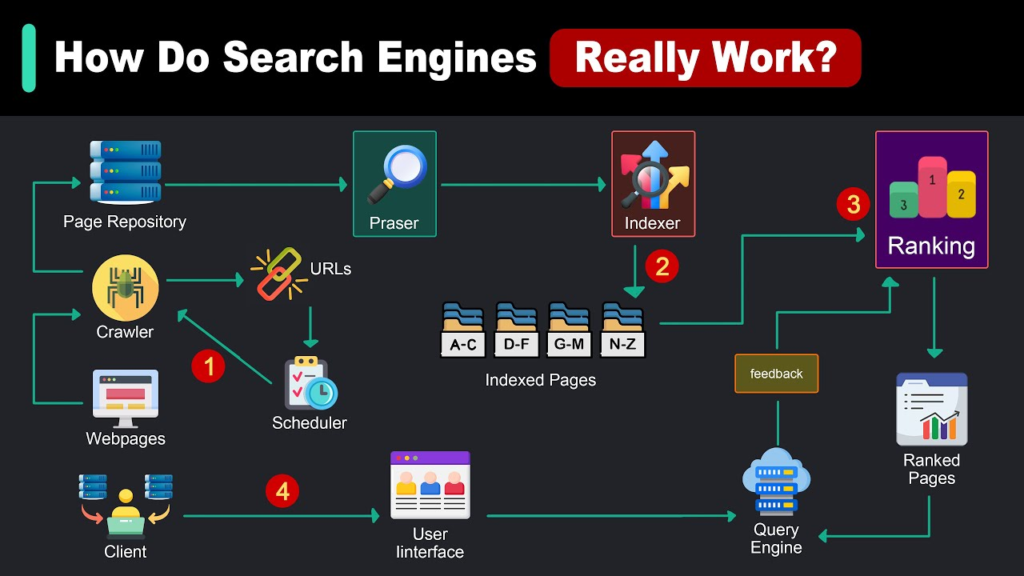
To successfully win the search ranking game, you have to understand the basic mechanics of how these digital libraries operate behind the scenes. Search engines deploy a massive fleet of automated software programs called crawlers or spiders that constantly travel across the web, jumping from link to link to discover fresh pages.
When a crawler lands on your website, it scans your text files, inspects your images, and maps out your overall site layout. It then takes this collected data and stores it inside a massive, global database known as a search index.
The moment a human types a phrase into a search bar, the system runs that phrase through hundreds of complex mathematical calculations to find the most relevant, secure, and user-friendly pages within its index to display on the user’s screen in milliseconds.
The Importance of Keywords
Keywords are the essential verbal bridges connecting human thoughts with digital content. They are the exact conversational phrases and everyday questions that your target audience types into a search bar when they are trying to solve a problem. Mastering semantic intent research means stepping completely outside of your corporate jargon and learning to speak the exact language of your customers.
[Outdated SEO Strategy] ──► Keyword Stuffing ──► Awkward, Robotic Text ──► Severe Ranking Penalties

                                                       VS.

[Modern SEO Strategy]   ──► Semantic Context ──► Natural Human Flow  ──► Sustained Ranking Growth
In the early days of the internet, you could easily trick search engines by copy-pasting the same word a hundred times in your footer. Try that today, and the system will instantly flag your site as spam and ban you from the index. Modern search engines are incredibly smart; they look for natural variations, synonyms, and context. Your goal is to weave your target phrases smoothly and naturally into your headings and paragraphs so the text reads beautifully for a real human being.
Creating High-Quality Content

There is an old, undeniable law in the digital marketing world that remains absolutely true: content is king. You can implement the most advanced technical tricks on earth, but if your website consists of shallow, boring, or stolen articles, visitors will hit the back button within three seconds. Search engines closely track this quick exit behavior, and they will quickly drop your ranking if your site fails to satisfy the user.
High-quality content is about creating deep, comprehensive resources that genuinely solve problems. It means writing text that is incredibly easy to scan, structuring your ideas with logical headings, using helpful bullet points, and packing your pages with real-world value. When you create articles that truly help people, your readers naturally stay on your site longer, share your links on social media, and bookmark your pages—all of which signal to search systems that your site is a premium resource.
On-Page SEO Essentials
On-page optimization is the strategic practice of organizing individual web pages so that search engines can easily decipher exactly what topic you are discussing. Think of it like putting clear, descriptive labels on storage boxes so the librarian knows exactly what is hidden inside each folder through structural metadata alignment.
- Title Tags: The prominent, blue clickable headline that appears directly on the search results page. This needs to be highly engaging and contain your primary target keyword.
- Meta Descriptions: The short summary paragraph nested beneath the headline. It acts like a mini sales pitch, convincing the user to click your link instead of a competitor’s.
- Header Tags (
H2,H3): These break your long-form text down into readable, bite-sized sections, making it accessible for both skimming readers and automated crawlers. - Image Alt Text: A hidden text description added to your photos, allowing search systems to “see” your images and index them inside image search results.
The Role of Technical SEO
You can have the most beautiful, well-written article in your entire industry, but if your website takes ten seconds to load or throws a bunch of broken errors, your search rankings will suffer. Technical optimization ensures your site’s backend code is clean, light, and perfectly configured for automated indexing engines through infrastructure efficiency tuning.
                                 ┌──► Accelerates Mobile Page Loading Speeds
                                 │
[Technical Infrastructure] ──────┼──► Implements Secure HTTPS Data Encryption
                                 │
                                 └──► Fixes Broken 404 Links & Server Redirects
A technically sound website features a highly logical directory structure, a clean XML sitemap that guides crawlers efficiently, secure data encryption protocols, and zero broken links. By clearing out these technical roadblocks, you make it incredibly easy for search engines to crawl your database without wasting their computing budget, which directly translates into faster ranking updates.
Mobile Optimization Is Essential

We live in a mobile-first society. The vast majority of your target audience is scanning your website on a compact smartphone screen while walking down the street, sitting on a train, or lounging on a couch. Because of this massive shift in human behavior, search engines practice mobile-first indexing initialization.
This means Google evaluates the smartphone layout of your website as the primary baseline to determine your ranking score. If your mobile layout forces users to manually pinch and zoom to read your text, features microscopic buttons that are impossible to tap, or slows down on a cellular connection, your visibility will drop. Your design must be fluid, lightning-fast, and look gorgeous on absolutely every screen size.
Understanding Local SEO
If you operate a physical brick-and-mortar storefront—like a local dental clinic, a boutique coffee shop, or a neighborhood law practice—traditional global rankings don’t matter much to you. You need to dominate your immediate geographical footprint using hyper-local perimeter targeting.
[Global Search Target] ──► "Best Coffee Beans"  ──► Competes Globally ──► Mass Market Audience

                                                       VS.

[Local Search Target]  ──► "Coffee Shop Near Me" ──► Targets Proximity  ──► Immediate Foot Traffic
Local search optimization ensures your business appears at the top of the map pack when nearby customers search for your services on their phones. To win this space, you must claim and optimize your official Google Business Profile, maintain perfectly matching name, address, and phone number data across the web, and consistently collect authentic, five-star customer reviews to signal local reliability.
The Power of a Link Building
In the eyes of a search engine, the internet is essentially a massive popularity contest. Every single time another reputable website places a link on their page that points directly back to your content, they are essentially casting a powerful algorithmic vote of confidence for your brand. These incoming links are known as backlinks.
However, the modern digital landscape values link quality far over raw quantity. A single backlink coming from a highly respected national news site or an accredited university domain carries more ranking power than a thousand spammy links from shady link directories. Focus on earning these digital endorsements naturally by publishing original research data, launching ultimate guides, and networking with real industry peers.
Core Digital Optimization Matrix
| Optimization Pillar | Core Operational Impact |
| Intent Curation | Matches your page text with the real-world questions your buyers are asking. |
| Code Refactoring | Slashes server response delays to prevent impatient users from hitting the back button. |
| Authority Endorsement | Earns high-trust backlinks to build your digital reputation. |
| Local Pack Mapping | Drives physical foot traffic by dominating location-specific map search queries. |
Measuring SEO Success
The absolute worst way to manage an optimization strategy is to fly completely blind without real-world data tracking. SEO is an ongoing process of data collection and calculation, requiring regular check-ins using tools like Google Analytics and Search Console to perform a thorough performance metric synthesis.
[Blind Marketing] ──► Post & Pray Strategy ──► Zero Performance Data ──► Wasted Energy

                                                       VS.

[Data-Driven SEO] ──► Live Click Tracking  ──► Continuous Tweaks     ──► Scaleable Revenue
Keep a close, analytical eye on your organic traffic growth trends, your primary keyword ranking movements, your click-through rates, and your user engagement metrics. More importantly, track your conversion rates—the actual percentage of search visitors who sign up for your newsletter or buy your products. This metrics tracking helps you spot your top-performing pages and double down on what is actively driving revenue.
Common SEO Mistakes to Avoid
Many well-meaning business owners accidentally kill their search visibility by clinging to completely outdated, dangerous marketing habits. One of the biggest mistakes is writing your text solely for the search engine instead of a real human being, resulting in stiff, unreadable copy that drives your human audience away.
Other hidden ranking killers include publishing identical duplicate content across multiple pages, letting massive unoptimized images slow your site speed down, and neglecting to fix broken links. Remember that search engines are ultimately built to serve human searchers. If you always prioritize building a beautiful, intuitive, and remarkably helpful experience for your real human visitors, your technical rankings will naturally follow.
Building Long-Term Online Growth
The single greatest advantage of investing in a robust search optimization strategy is its incredible ability to generate sustainable, long-term business wealth. When you stop relying entirely on expensive paid social media ads, your business gains incredible financial freedom. Paid advertising is a volatile tap—the exact second your budget runs dry, your traffic drops down to zero.
An optimized piece of web content, however, acts like a premium piece of digital real estate. Once you secure a top-tier organic ranking for a valuable keyword, that single page will continue to pull in highly qualified, eager buyers day after day, month after month, completely for free. It requires initial patience, consistency, and hard work to build, but the long-term payoff is a self-sustaining marketing engine that scales your business automatically while you sleep.